Does the Japan case overthrow buy and hold?
Continuing on the subject of risk on the stock market and taking advantage of a comment made in the last post, let's talk about the case of the Japanese market. For 20 years, more precisely from 1989 to 2009, the Nikkei had a negative annualized return.
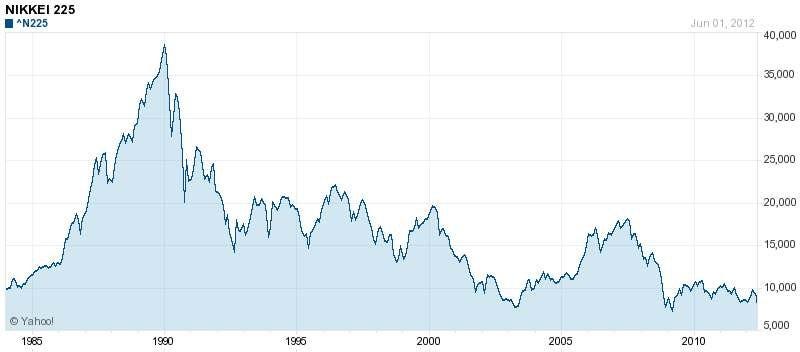 The Nikkei's Terrible 20s: Every Investor's Biggest Fear
According to this fact, it is possible that some people consider buy and hold as an erroneous strategy. But we can better analyze the markets, indices and moments and compare whether the problem really lies in this way of investing.
The Japanese market had been on a completely unfounded rise for almost 20 years. Over the last 10 years, the Nikkei index had appreciated on average 21.2% per year and the numbers began to become too bloated. The shares were trading at a price above 80 times earnings, showing the total irrationality of the period. To give you an idea, a market is considered overvalued when its P/L is above 22.5. One day the bubble would burst.
And the fact that I consider most important and that completely changes the results, is that the Nikkei 225 index, like the DJI, does not count stock dividends. Just don't ask me why. And even with all the drop in the index disregarding dividends, there were still stocks that appreciated in value, stocks that were not valued at the same absurd average as the market.
Another thing we must take into consideration is that there is a big difference between countries. Brazil and Japan have a completely different market, economy and moment. In 1989, Japan was already a stabilized and mature economy. A different case from the one we live in Brazil today, we still have a lot to evolve in economic and financial terms.
Above all, no matter how bad buy and hold may have been in this period, any other type of strategy within the stock market would be worse. Nobody is a magician when it comes to timing these tops and bottoms. It is completely wrong to focus only on the exception of a strategy that is winning over long periods.
And what can we conclude from this whole story?
Just like in the American bubble at the beginning of the last decade, the P/L of the Japanese market was well above what was considered overvalued. The biggest problem is that we could even be able to identify a future bubble or swelling in prices through this, but how would we know when it would burst? The market could very well continue to rise for many years without any problems. It's something that requires a lot of study and discipline to avoid getting into this frenetic optimism. In my case, I would never invest in stocks with a P/L that high.
Originally published on 10/10/2010 https://rendapassiva.wordpress.com/2010/10/10/o-caso-do-japao-derruba-o-buy-and-hold (my old anonymous blog), with some corrections and adaptations.
Originally published on MEDIUM