Does the Japan case overthrow buy and hold?
Back to stock market risk, this time because of a comment on the last post about the Japanese market. For 20 years, from 1989 to 2009, the Nikkei had a negative annualized return.
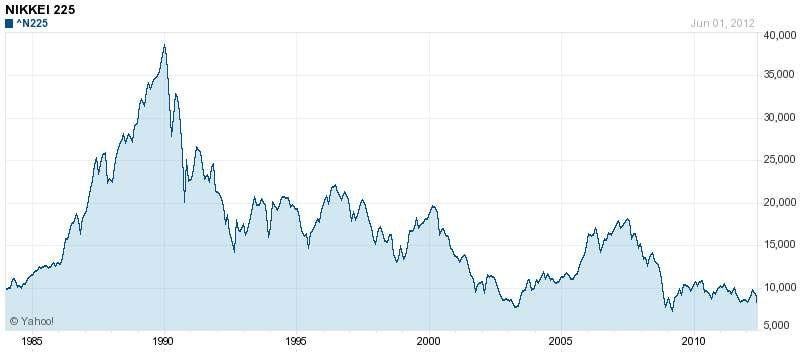
The Nikkei's Terrible 20s: Every Investor's Biggest Fear
Because of this, some people may see buy and hold as a bad strategy. But we can look more closely at the markets, the indices and the timing, and check whether the problem really is this way of investing.
The Japanese market had risen for almost 20 years with nothing to justify it. Over the previous 10 years, the Nikkei had gained 21.2% per year on average, and the numbers got too inflated. Shares traded above 80 times earnings, which shows how irrational the period was. For comparison, a market is considered overvalued when its P/E is above 22.5. Sooner or later the bubble would burst.
The fact I consider most important, and the one that changes the results completely, is that the Nikkei 225, like the DJI, does not count dividends. Don't ask me why. And even with the whole fall in the index, ignoring dividends, some stocks still rose in value: the ones that were not priced at the same absurd average as the market.
We also have to consider how different the two countries are. Brazil and Japan have completely different markets, economies and moments. In 1989, Japan was already a stable, mature economy. Brazil today is a different case: we still have a lot to develop in economic and financial terms.
Above all, however bad buy and hold was in this period, any other stock market strategy would have done worse. Nobody is a magician at timing these tops and bottoms. It makes no sense to judge a strategy that wins over long periods by its one exception.
So what can we take from this story?
As in the American bubble at the start of the last decade, the Japanese market's P/E was well above the overvalued line. The biggest problem is that even if we could spot a coming bubble this way, how would we know when it would burst? The market could keep rising for many years with no trouble. It takes a lot of study and discipline not to get caught in that frantic optimism. Personally, I would never invest in stocks with a P/E that high.
Originally published on 10/10/2010 on my old anonymous blog, with some corrections and adaptations.
Originally published on Medium
Comments